
Principal Investigator
Mohamed Lamkanfi
Research interests
Our laboratory studies how inflammasome signaling and pyroptotic cell death are regulated, and how these processes shape inflammation and disease. Specifically, we focus on:
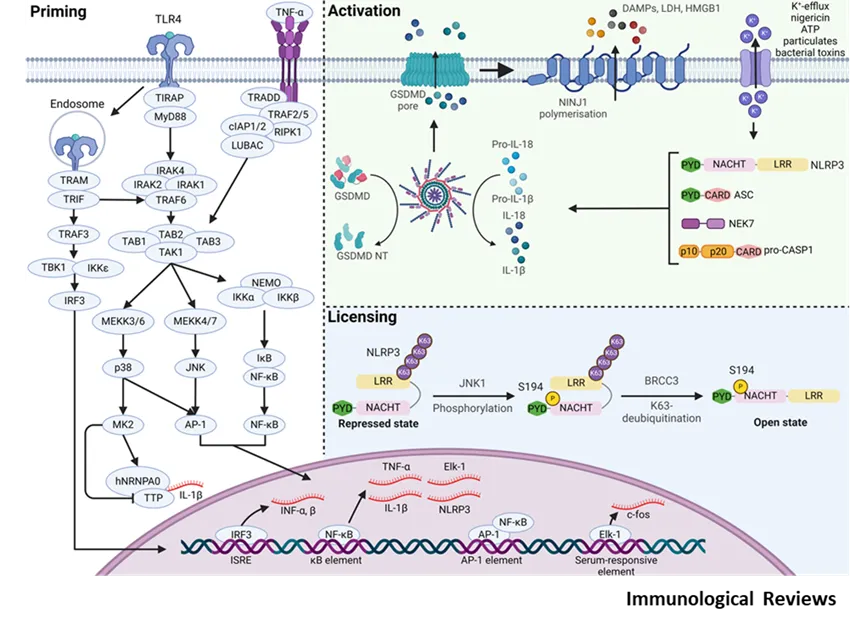
- How inflammasomes are activated, including the signaling pathways driving priming, licensing and post-translational modifications that control their activity.
- How pyroptosis is executed downstream of inflammasomes, and how Gasdermin-mediated membrane permeabilization coordinates cytokine release and inflammatory responses.
- How inflammasome activation and pyroptosis function in vivo in the context of infections and inflammatory diseases.
- Translating mechanistic insights into functional diagnostics and contributing to the development of novel therapeutic strategies to modulate inflammasome-driven disease trajectories.
Selected publications
- Vande Walle L†, Kato K.†, Yamagishi M., Kamatani T, Vervaeke A, Martín-Pérez R, Shimizu M., Takizawa T, Takita J, Nishikomori R, Ohara O, Izawa K*, Shirasaki Y*, Lamkanfi M* (2025) Single-cell analysis reveals cell death as driver of NLRP3-mediated secretion of IL-1ß in human monocytes. Nature Immunology 26(12):2148-2158.†,*Equal contribution
- Single-cell imaging and secretion assays reveal that only a small subset (~5–10%) of human monocytes accounts for the majority of extracellular IL-1β production following NLRP3 inflammasome activation
- These high-producing cells undergo pyroptosis driven by caspase-1 and gasdermin D, linking IL-1β release to lytic cell death rather than secretion from viable cells
- The findings redefine IL-1β as a damage-associated molecular pattern (DAMP) predominantly released by dying monocytes
- In inflammatory conditions such as CAPS, excessive IL-1β production is largely driven by inflammasome-mediated pyroptotic cell death rather than uniform cytokine secretion across all cells
- Van Gorp H., Huang L., Saavedraa P.H.V, Vuylsteke M, Asaoka T., Prencipe G., Insalaco A., Ogunjimi B., Jeyaratnam J., Cataldo I., Jacques P., Vermaelen K.Y, Dullaers M., Joos R., Sabato V., Stella A., Frenkel J., De Benedetti F., Dehoorne J., Haerynck F., Calamita G., Portincasa P., Lamkanfi M. (2020) A blood-based test for diagnosis and functional subtyping of Familial Mediterranean Fever. Annals of the Rheumatic Diseases 79(7):960-968.
- Developed a functional blood-based assay that measures inflammasome-dependent cytokine release to support diagnosis of Familial Mediterranean Fever
- Using an ex vivo colchicine challenge in PBMCs or whole blood, the assay robustly distinguishes FMF patients from healthy individuals and those with related inflammatory conditions
- The approach enables functional subtyping of Pyrin inflammasome–associated autoinflammation
- It also supports interpretation of pathogenic versus benign MEFV variants, improving genetic diagnosis and clinical decision-making
- Saavedra PHV, Huang L, Ghazavi F, Kourula S, Vanden Berghe T, Takahashi N, Vandenabeele P, Lamkanfi M. (2018) Apoptosis of intestinal epithelial cells restricts Clostridium difficile infection in a model of pseudomembranous colitis. Nature Communications 9(1):4846. doi: 10.1038/s41467-018-07386-5.
- The study shows that C. difficile toxins trigger intrinsic apoptosis in intestinal epithelial cells (IECs) and organoids rather than inflammasome-driven pyroptosis.
- IEC apoptosis is mediated by caspase-3 and caspase-7 and is functionally important for host defense. Genetic deletion of caspase-3/7 in IECs reduced toxin-induced apoptosis and increased susceptibility to epithelial damage.
- Despite C. difficile infection known to induce inflammasome activation in immune cells, IEC death and disease progression in this model of pseudomembranous colitis occur independently of inflammasome signaling.
- IEC apoptosis restricts bacterial expansion and limits infection severity in vivo, highlighting a protective role for epithelial apoptosis in pseudomembranous colitis.
- Kanneganti A, Malireddi RKS, Saavedra PHV, Vande Walle L, Van Gorp H, Kambara H, Tillman H, Vogel P, Luo HR, Xavier RJ, Chi H, Lamkanfi M. (2018) GSDMD is critical for autoinflammatory pathology in a mouse model of Familial Mediterranean Fever. Journal of Experimental Medicine 4;215(6):1519-1529
- Using a mouse model of Familial Mediterranean Fever, the study investigates how Pyrin inflammasome activation drives autoinflammation
- gasdermin D–mediated pyroptosis is shown to be essential for systemic IL-1β production and the development of inflammatory pathology
- Genetic deletion of gasdermin D fully protects mice from systemic inflammation, neutrophilia, and tissue damage
- These findings identify pyroptosis as a central driver of disease pathology and highlight it as a promising therapeutic target in inflammasome-driven autoinflammation
- Vande Walle L., Van Opdenbosch N., Jacques P., Fossoul A., Beyaert R., Elewaut D., Kanneganti T-D., Van Loo G.*, Lamkanfi M.* (2014) Negative regulation of Nlrp3 inflammasome by A20 protects against arthritis. Nature 512(7512):69-73
- Identifies A20 as a key negative regulator of the NLRP3 inflammasome in macrophages
- Myeloid-specific deletion of A20 enhances NLRP3 priming and activation, resulting in increased caspase-1 activation, pyroptosis, and IL-1β production
- Genetic deletion of NLRP3, caspase-1, or the Interleukin-1 receptor protects A20-deficient mice from inflammatory arthritis
- Demonstrates that uncontrolled NLRP3 signaling is a key driver of inflammatory disease pathology